The short answer
None of the three largest helpdesk vendors sells a service level agreement on the accuracy of AI answers. Their SLAs cover uptime. For AI, they publish a resolution rate or a deflection rate: the share of conversations that ended without a human, counted in each vendor's own way.
Independent and third-party tests usually report much lower numbers than the vendors. The gap comes mostly from how "resolved" is counted, and from the quality of each customer's knowledge base.
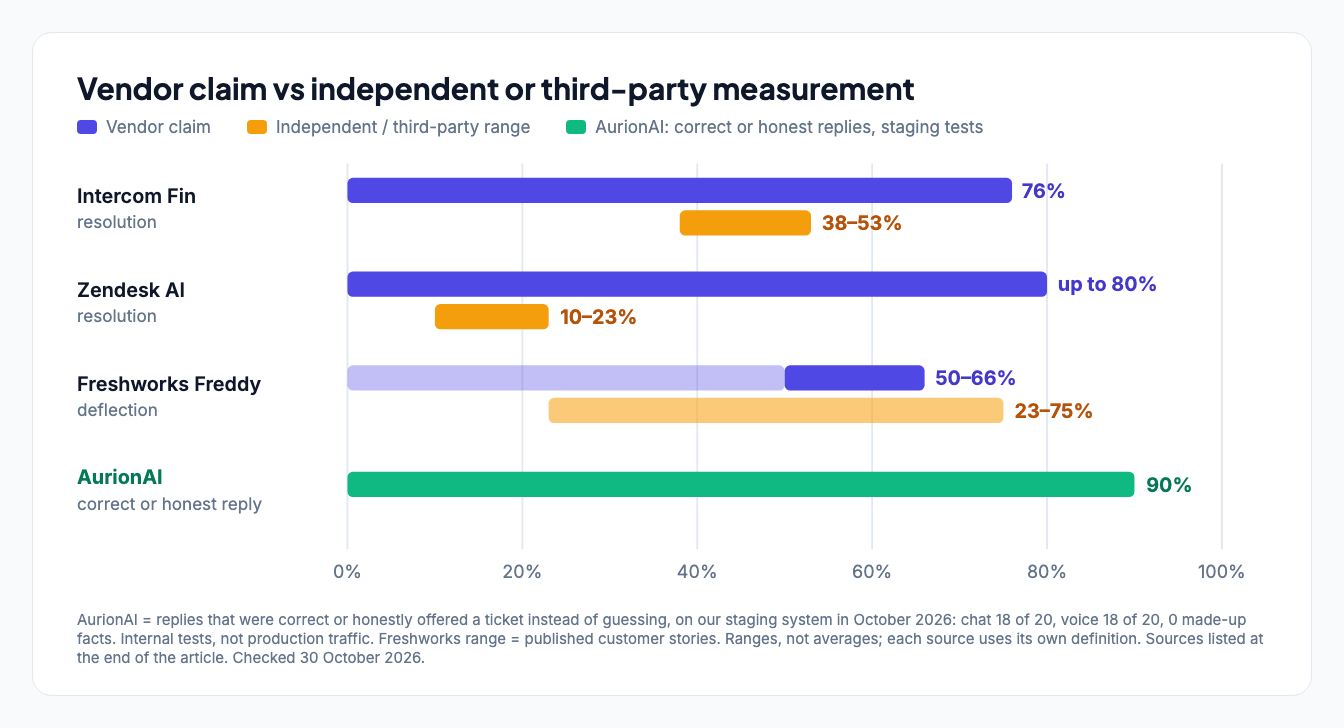
What each vendor publishes
| Intercom Fin | Zendesk AI agents | Freshworks Freddy | |
|---|---|---|---|
| Vendor figure | 76% average resolution [1] | "up to 80%" of interactions [8] | 50-66% deflection [10][11] |
| Independent or third-party | 38% on 500 tickets [5]; 45-53% (competitor) [6] | 10-20% (competitor) [8]; 23% after 6 months, one customer [9] | 23-75% in published customer stories [12] |
| Guarantee | Resolution guarantee for customers above 250,000 conversations a month [2][3] | None found | None found |
| What it measures | Conversations closed without a human | Contained and verified resolutions (definition changed May 2026) [7] | Requests deflected before an agent |
Intercom Fin
Intercom reports that Fin's average resolution rate has grown to 76% across more than 12,000 customers [1]. It also runs the Fin Guarantee: a refund program for new customers, and a resolution-rate guarantee of 65% that is open only to high-volume customers with more than 250,000 conversations a month in North America and Europe [2][3].
Independent figures are lower. A review of 500 tickets across four small businesses found 38% [5]. A competitor's analysis reports 45-53% in production [6]. One reason: Fin counts a conversation as resolved when the customer leaves or goes quiet, without confirming the answer helped.
Intercom has also published a head-to-head test against Zendesk: Fin answered questions that need several sources 96% of the time against 78% for Zendesk, with no significant difference in hallucination levels [4]. Intercom ran that test itself. Kommunicate, which sells a competing product but published its test data, reports 98.8% accuracy for Fin on 85 questions and 54.5% for Zendesk on 11 English questions [13].
Zendesk AI agents
Zendesk markets AI agents that can resolve up to 80% of interactions, without a published method, sample or date [8]. On 18 May 2026 Zendesk changed its automated-resolution reporting to include both contained and verified resolutions, so figures from before and after that date do not compare [7].
Third-party figures are far lower: 10-20% in a competitor's demo data and reviews [8], and 23% after six months for one customer [9]. We found no published accuracy rate for Zendesk AI agents.
Freshworks Freddy
Freshworks reports average deflection of about 50%, up to 80% for mature deployments, and 66% on Freshservice self-service [10][11]. Published customer stories range from 23% to 75% [12].
Deflection is not resolution: it counts requests that never reached an agent, with a different denominator. We found no published accuracy data for Freddy.
Why the numbers disagree
Three things explain most of the gap:
- The definition of "resolved". A chat that ends because the customer gave up can count as resolved.
- The denominator. Deflection, containment and resolution count different things.
- The knowledge base. Every source agrees that coverage and quality of the customer's articles drive results more than the AI model does.
That is why a vendor average says little about how a tool will perform on your articles and your customers' questions.
How we measure answer quality at AurionAI
We do not publish a resolution rate yet: AurionAI has not been measured on production traffic. Before launch, we test the engine that answers both voice calls and chat on two knowledge bases, in French, English, German and Dutch:
- our own knowledge base of 1,694 articles, where many articles look alike;
- a 128-article knowledge base imported from an ITSM tool, written the way customers write their help articles.
For every test question we check five things:
| What we check | Result (internal tests, October 2026) |
|---|---|
| The right article is in the top three search results, customer-style KB | 92-100% per language, mostly questions asked in another language than the article |
| The right article is in the top three search results, our large KB | 81-94% per language |
| Replies that were correct, or honestly offered a ticket instead of guessing (staging system) | 90%: chat 18 of 20, voice 18 of 20, 0 made-up facts |
| Questions with no answer in the KB are handled honestly | 8 of 8: the AI says it does not know or offers a ticket |
| Replies containing a statement the article does not support | 3 of 80 test conversations |
We publish the last number because it is the one that matters most to customers, and because we are still working to bring it to zero.
In chat, AurionAI sends a knowledge-base answer only after a separate AI check finds each claim in the article. If the check fails, the customer is offered a ticket instead of a guess. Voice and chat use the same hybrid search, which combines keyword matching with meaning-based (vector) search, in the caller's language.
How to compare AI support tools fairly
- Ask for the definition before the number. What counts as resolved, and what is the denominator?
- Ask for accuracy, not only deflection. A customer who leaves with a wrong answer is not a saving.
- Test on your own knowledge base. Use your articles, your customers' real questions and the same scoring for every tool.
- Check the date. Vendors change how they count and what they guarantee; every figure in this article was checked on 30 October 2026.
If you want to see these measurements on your own knowledge base, book a demo and we will run them with you.
Sources
Figures as published by each source, checked on 30 October 2026. None is independently audited. Sources marked "competitor" sell a rival product.
- Intercom, From resolutions to outcomes: evolving how Fin delivers value
- Intercom, The Fin Million Dollar Guarantee
- Intercom Help Center, What is the Fin Guarantee?
- Intercom, Intercom vs Zendesk: two AI agents put to the test (vendor-run test)
- Builts, Intercom Fin AI review: we tested it on 500 tickets
- CloneDesk (competitor), Intercom Fin resolution rate: 45-53% in production
- eesel AI (competitor), Zendesk AI agent resolution rate: read the new AR%
- Richpanel (competitor), Zendesk AI agents in 2026: setup, costs and honest limits
- Lorikeet (competitor), What resolution rate can AI customer support achieve?
- Freshworks, Freshservice Benchmark Report 2025
- Barchart, Freshworks launches new AI capabilities
- eesel AI (competitor), Freshservice ticket deflection
- Kommunicate (competitor), Intercom Fin alternatives: we tested 4 AI agents
Frequently Asked Questions
- Do Intercom, Zendesk or Freshworks offer an SLA on AI answer accuracy?
- No. Their service level agreements cover availability (uptime). For AI answers they publish resolution or deflection rates, which measure how many conversations ended without a human, not whether the answer was correct. Intercom has a resolution-rate guarantee, but only for customers with more than 250,000 conversations a month.
- What resolution rate does Intercom Fin claim?
- Intercom reports an average resolution rate of 76% across its customers. Independent and third-party tests report lower figures, from 38% on a 500-ticket review to 45-53% in a competitor's analysis. Intercom counts a conversation as resolved when the customer leaves or stays silent, which explains part of the gap.
- Is a deflection rate the same as a resolution rate?
- No. Deflection counts requests that never reached a human agent, often through self-service. Resolution counts conversations the AI closed. They use different denominators, so a deflection rate cannot be compared with a resolution rate.
- How does AurionAI measure AI answer quality?
- We measure, per language, whether the search finds the right article in the top three results, whether the reply gives the correct steps from that article, whether it answers in the caller's language, and how many statements the article does not support. In chat, a separate AI check must find each claim in the article before the answer is sent; otherwise the customer is offered a ticket.
- What is the best way to compare AI support tools?
- Run every tool on your own knowledge base and your own customer questions, with the same definition of a correct answer. Vendor averages and analyst summaries use different definitions and samples, and none of the figures in this article is independently audited.